

No products in the cart.
 All Categories
Description
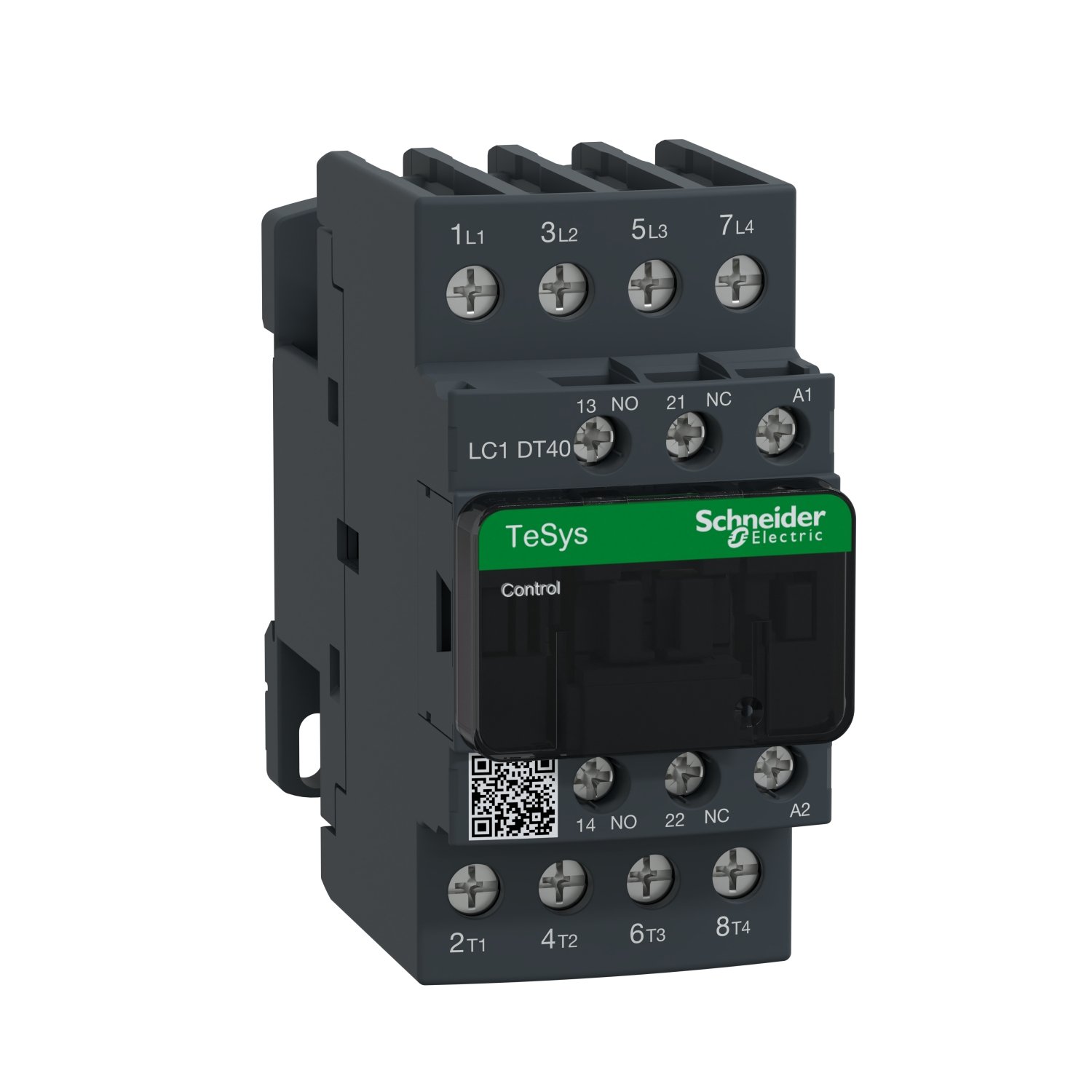
Schneider LC1DT32M7 | TeSys D contactor – 4P(4 NO) – AC-1 – <= 440 V 32 A – 220 V AC 50/60 Hz coil
Schneider LC1DT32M7 Description
Introduction to Schneider LC1DT32M7
it is a powerful and reliable contactor designed for a wide range of industrial applications. It is part of Schneider Electric’s TeSys D series, known for its high performance and durability. This contactor is built to provide efficient motor control and ensure smooth operation in various industrial settings.
Specifications of Schneider LC1DT32M7
it comes with the following specifications:
Voltage Rating
The contactor is rated for operating voltages up to 690 volts, making it suitable for both low and high voltage applications.
Power Rating
With a power rating of 32 amps, it can handle heavy loads with ease, making it ideal for demanding industrial environments.
Coil Voltage
The contactor features a coil voltage of 24 volts, ensuring reliable activation and deactivation of the switching mechanism.
Contact Configuration
It is equipped with 3 normally open (NO) main poles, allowing for efficient control of electrical circuits.
Control Circuit Voltage
it operates on a control circuit voltage of 220-240 volts AC, ensuring compatibility with standard industrial power systems.
Features
Compact Design
Despite its robust performance, it boasts a compact and space-saving design, making it easy to integrate into existing electrical panels and enclosures.
Reliable Performance
Built with high-quality materials and precision engineering, it delivers consistent and reliable performance, ensuring uninterrupted operation even in harsh industrial environments.
Easy Installation
The contactor is designed for easy installation, with clearly marked terminals and intuitive wiring diagrams, allowing for quick and hassle-free setup.
Applications
Schneider LC1DT32M7 finds wide application in various industrial sectors, including:
- Industrial automation
- Motor control
- HVAC (Heating, Ventilation, and Air Conditioning) systems
Benefits of Using Schneider LC1DT32M7
Energy Efficiency
By providing efficient motor control, Schneider LC1DT32M7 helps optimize energy usage, reducing overall power consumption and operational costs.
Cost-Effectiveness
With its durable construction and long service life, it offers excellent value for money, minimizing the need for frequent replacements or repairs.
Durability
Constructed to withstand the rigors of industrial use, Schneider LC1DT32M7 is built to last, ensuring reliable performance even in demanding operating conditions.
Installation Process of Schneider LC1DT32M7
Installing i is a straightforward process that can be completed in a few simple steps:
- Ensure power to the circuit is switched off before starting installation.
- Mount the contactor securely in the desired location using appropriate mounting hardware.
- Connect the control circuit wires to the designated terminals on the contactor, following the wiring diagram provided.
- Verify proper connection and insulation of all wires before restoring power to the circuit.
Maintenance Tips
To ensure optimal performance and longevity, it is recommended to follow these maintenance tips:
- Perform regular visual inspections to check for signs of wear or damage.
- Clean the contactor and surrounding area periodically to remove dust and debris that may affect performance.
- Replace worn or damaged parts promptly to prevent further issues.
Despite its reliability, Schneider LC1DT32M7 may encounter occasional issues. Here are some common problems and their solutions:
Overheating
Ensure proper ventilation and cooling for the contactor to prevent overheating. Check for loose connections or overloaded circuits that may contribute to excessive heat buildup.
Coil Failure
Inspect the coil for signs of damage or wear, such as burnt insulation or corrosion. Replace the coil if necessary to restore proper functionality.
Contact Welding
If the contacts become welded together due to excessive current or arcing, carefully separate them using insulated tools. Investigate the root cause of the welding and address any underlying issues to prevent recurrence.
Comparison with Other Similar Products
Schneider LC1DT32M7 stands out from its competitors due to its superior performance, reliability, and cost-effectiveness. Compared to other contactors in its class, it offers unmatched durability and efficiency, making it the preferred choice for industrial applications.
Conclusion
Schneider LC1DT32M7 is a versatile and reliable contactor that offers superior performance and durability for a wide range of industrial applications. With its compact design, easy installation, and energy-efficient operation, it provides an ideal solution for motor control and automation needs.
Additional information
| brands | Schneider Electric |
|---|
Specifications
| Range | TeSys TeSys Deca |
|---|---|
| Range of product | TeSys Deca |
| product or component type | Contactor |
| Device short name | LC1D |
| Contactor application | Resistive load |
| Utilisation category | AC-1 AC-3 AC-3e AC-4 |
| Poles description | 4P |
| [Ue] rated operational voltage | Power circuit: <= 690 V AC 25...400 Hz Power circuit: <= 300 V DC |
| [Ie] rated operational current | 32 A (at <60 °C) at <= 440 V AC AC-1 for power circuit |
| [Uc] control circuit voltage | 220 V AC 50/60 Hz |
| Compatibility code | LC1D |
|---|---|
| Pole contact composition | 4 NO |
| Protective cover | With |
| [Ith] conventional free air thermal current | 10 A (at 60 °C) for signalling circuit 32 A (at 60 °C) for power circuit |
| Irms rated making capacity | 140 A AC for signalling circuit conforming to IEC 60947-5-1 250 A DC for signalling circuit conforming to IEC 60947-5-1 300 A at 440 V for power circuit conforming to IEC 60947 |
| Rated breaking capacity | 300 A at 440 V for power circuit conforming to IEC 60947 |
| [Icw] rated short-time withstand current | 40 A 40 °C - 10 min for power circuit 84 A 40 °C - 1 min for power circuit 145 A 40 °C - 10 s for power circuit 240 A 40 °C - 1 s for power circuit 100 A - 1 s for signalling circuit 120 A - 500 ms for signalling circuit 140 A - 100 ms for signalling circuit |
| Associated fuse rating | 10 A gG for signalling circuit conforming to IEC 60947-5-1 50 A gG at <= 690 V coordination type 1 for power circuit 35 A gG at <= 690 V coordination type 2 for power circuit |
| Average impedance | 2.5 mOhm - Ith 32 A 50 Hz for power circuit |
| Power dissipation per pole | 2.5 W AC-1 |
| [Ui] rated insulation voltage | Power circuit: 600 V CSA certified Power circuit: 600 V UL certified Signalling circuit: 690 V conforming to IEC 60947-1 Signalling circuit: 600 V CSA certified Signalling circuit: 600 V UL certified Power circuit: 690 V conforming to IEC 60947-4-1 |
| Overvoltage category | III |
| Pollution degree | 3 |
| [Uimp] rated impulse withstand voltage | 6 kV conforming to IEC 60947 |
| Safety reliability level | B10d = 1369863 cycles contactor with nominal load conforming to EN/ISO 13849-1 B10d = 20000000 cycles contactor with mechanical load conforming to EN/ISO 13849-1 |
| Mechanical durability | 15 Mcycles |
| Electrical durability | 1 Mcycles 32 A AC-1 at Ue <= 440 V |
| Control circuit type | AC at 50/60 Hz |
| Coil technology | Without built-in suppressor module |
| Control circuit voltage limits | 0.3...0.6 Uc (-40…70 °C):drop-out AC 50/60 Hz 0.8...1.1 Uc (-40…60 °C):operational AC 50 Hz 0.85...1.1 Uc (-40…60 °C):operational AC 60 Hz 1...1.1 Uc (60…70 °C):operational AC 50/60 Hz |
| Inrush power in VA | 70 VA 60 Hz cos phi 0.75 (at 20 °C) 70 VA 50 Hz cos phi 0.75 (at 20 °C) |
| Hold-in power consumption in VA | 7.5 VA 60 Hz cos phi 0.3 (at 20 °C) 7 VA 50 Hz cos phi 0.3 (at 20 °C) |
| Heat dissipation | 2…3 W at 50/60 Hz |
| Operating time | 4...19 ms opening 12...22 ms closing |
| Maximum operating rate | 3600 cyc/h 60 °C |
| Connections - terminals | Control circuit: screw clamp terminals 2 1…2.5 mm² - cable stiffness: flexible with cable end Control circuit: screw clamp terminals 1 1…4 mm² - cable stiffness: flexible without cable end Control circuit: screw clamp terminals 2 1…4 mm² - cable stiffness: flexible without cable end Control circuit: screw clamp terminals 1 1…4 mm² - cable stiffness: flexible with cable end Control circuit: screw clamp terminals 1 1…4 mm² - cable stiffness: solid without cable end Control circuit: screw clamp terminals 2 1…4 mm² - cable stiffness: solid without cable end Power circuit: screw clamp terminals 1 2.5…10 mm² - cable stiffness: flexible without cable end Power circuit: screw clamp terminals 2 2.5…10 mm² - cable stiffness: flexible without cable end Power circuit: screw clamp terminals 1 2.5…10 mm² - cable stiffness: flexible with cable end Power circuit: screw clamp terminals 2 2.5…10 mm² - cable stiffness: flexible with cable end Power circuit: screw clamp terminals 1 2.5…16 mm² - cable stiffness: solid without cable end Power circuit: screw clamp terminals 2 2.5…16 mm² - cable stiffness: solid without cable end |
| Tightening torque | Control circuit: 1.7 N.m - on screw clamp terminals - with screwdriver flat Ø 6 mm Control circuit: 1.7 N.m - on screw clamp terminals - with screwdriver Philips No 2 Control circuit: 1.7 N.m - on screw clamp terminals - with screwdriver pozidriv No 2 Power circuit: 1.8 N.m - on screw clamp terminals - with screwdriver flat Ø 6 mm Power circuit: 1.8 N.m - on screw clamp terminals - with screwdriver Philips No 2 Power circuit: 1.8 N.m - on screw clamp terminals - with screwdriver pozidriv No 2 |
| Auxiliary contact composition | 1 NO + 1 NC |
| Auxiliary contacts type | type mechanically linked 1 NO + 1 NC conforming to IEC 60947-5-1 type mirror contact 1 NC conforming to IEC 60947-4-1 |
| Signalling circuit frequency | 25...400 Hz |
| Minimum switching voltage | 17 V for signalling circuit |
| Minimum switching current | 5 mA for signalling circuit |
| Insulation resistance | > 10 MOhm for signalling circuit |
| Non-overlap time | 1.5 ms on de-energisation between NC and NO contact 1.5 ms on energisation between NC and NO contact |
| Mounting support | Plate Rail |
| Standards | CSA C22.2 No 14 EN 60947-4-1 EN 60947-5-1 IEC 60947-4-1 IEC 60947-5-1 UL 508 IEC 60335-1 |
|---|---|
| Product certifications | DNV GL CCC LROS (Lloyds register of shipping) RINA BV GOST UL CSA CB |
| IP degree of protection | IP20 front face conforming to IEC 60529 |
| Protective treatment | TH conforming to IEC 60068-2-30 |
| Climatic withstand | conforming to IACS E10 exposure to damp heat conforming to IEC 60947-1 Annex Q category D exposure to damp heat |
| Permissible ambient air temperature around the device | -40…60 °C 60…70 °C with derating |
| Operating altitude | 0...3000 m |
| Fire resistance | 850 °C conforming to IEC 60695-2-1 |
| Flame retardance | V1 conforming to UL 94 |
| Mechanical robustness | Vibrations contactor open (2 Gn, 5...300 Hz) Vibrations contactor closed (4 Gn, 5...300 Hz) Shocks contactor closed (15 Gn for 11 ms) Shocks contactor open (8 Gn for 11 ms) |
| Height | 91 mm |
| Width | 45 mm |
| Depth | 99 mm |
| Net weight | 0.425 kg |
| Unit Type of Package 1 | PCE |
|---|---|
| Number of Units in Package 1 | 1 |
| Package 1 Height | 5.800 cm |
| Package 1 Width | 9.800 cm |
| Package 1 Length | 12.000 cm |
| Package 1 Weight | 466.000 g |
| Unit Type of Package 2 | S02 |
| Number of Units in Package 2 | 16 |
| Package 2 Height | 15.000 cm |
| Package 2 Width | 30.000 cm |
| Package 2 Length | 40.000 cm |
| Package 2 Weight | 7.997 kg |
| Warranty | 18 months |
|---|


Reviews
There are no reviews yet.