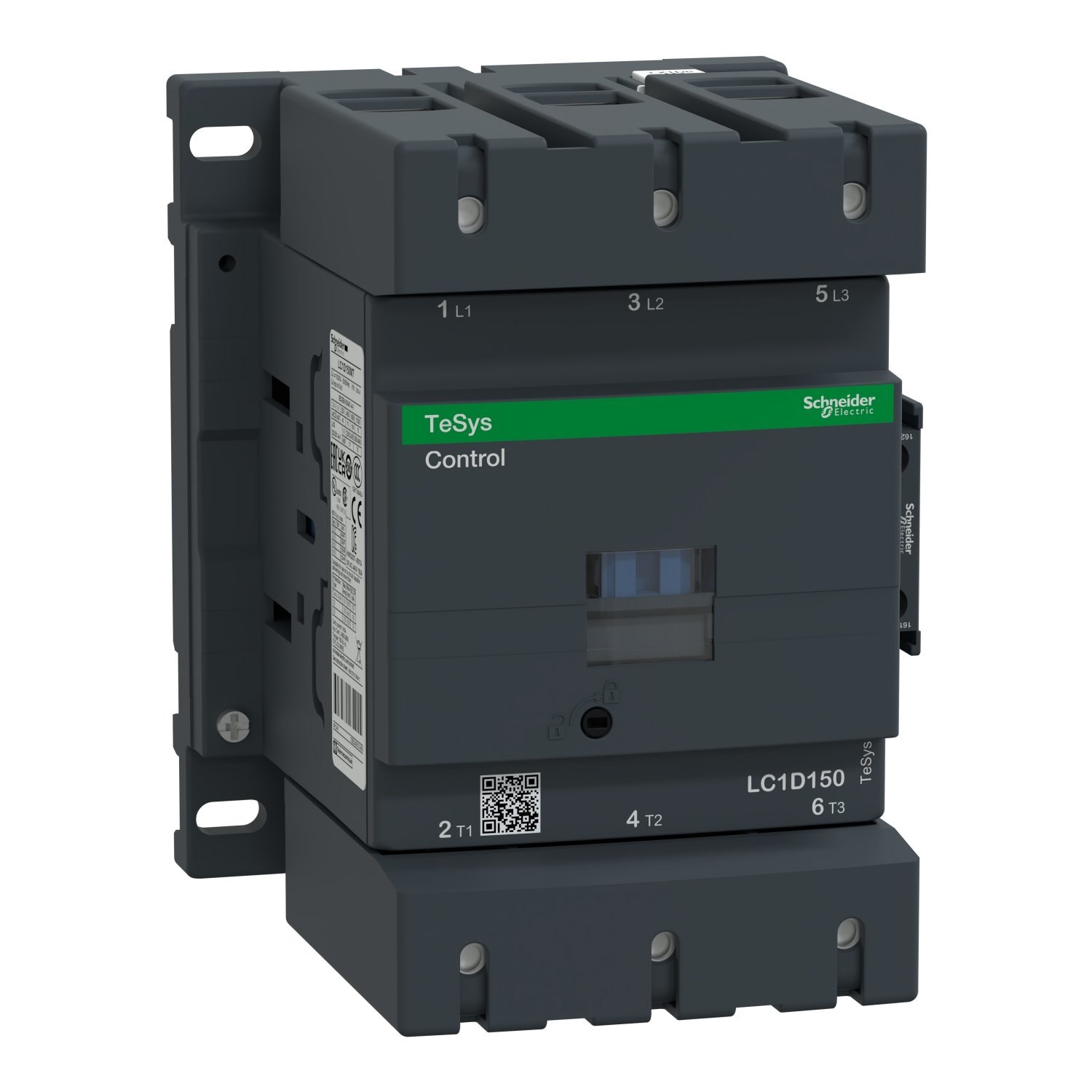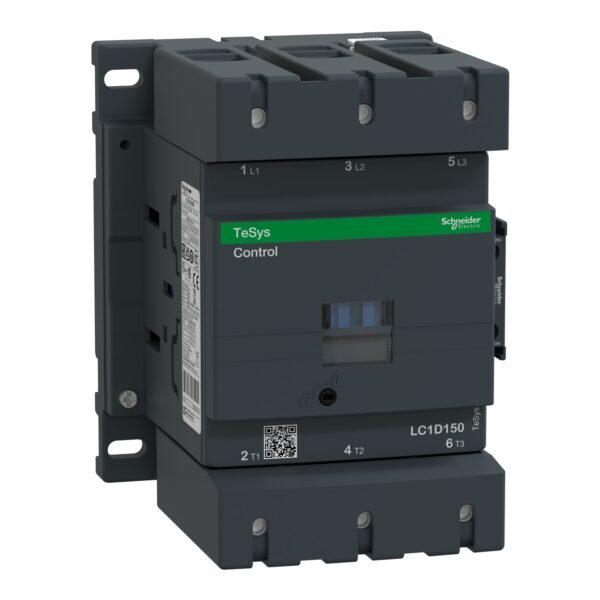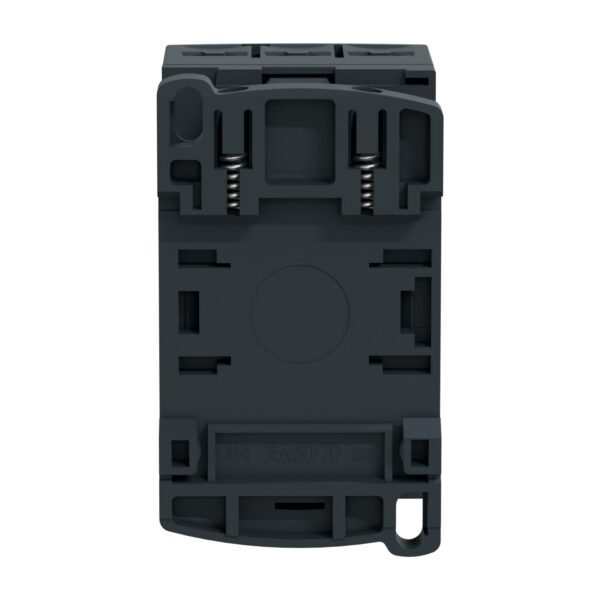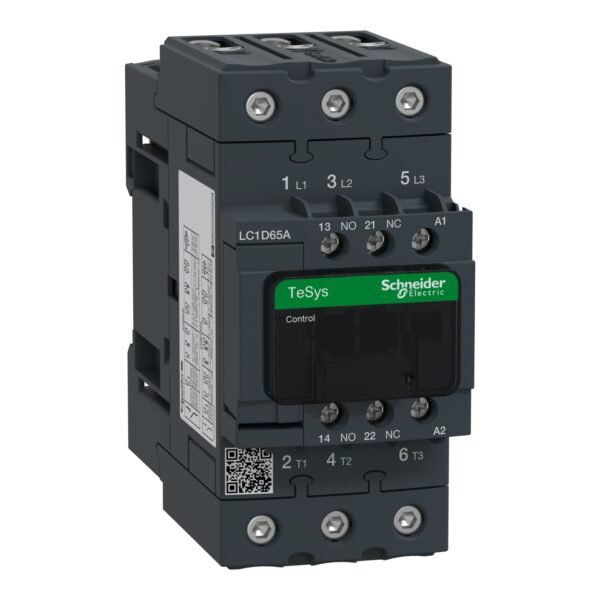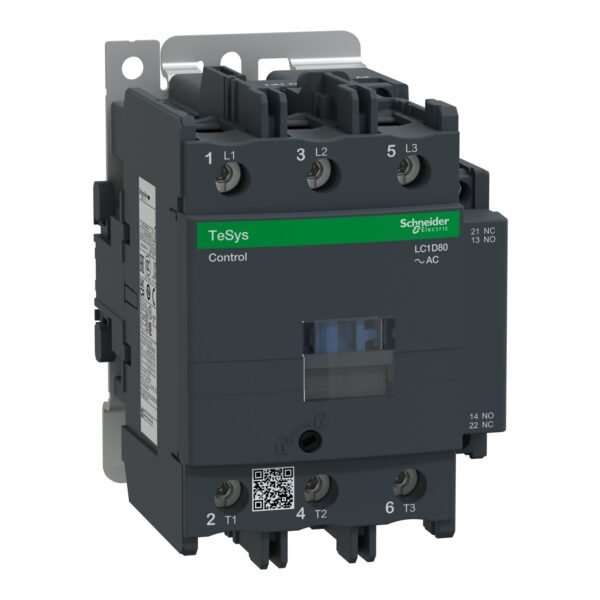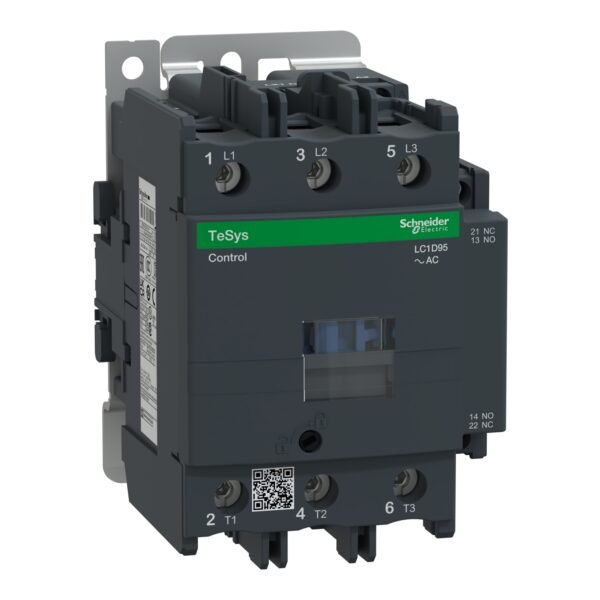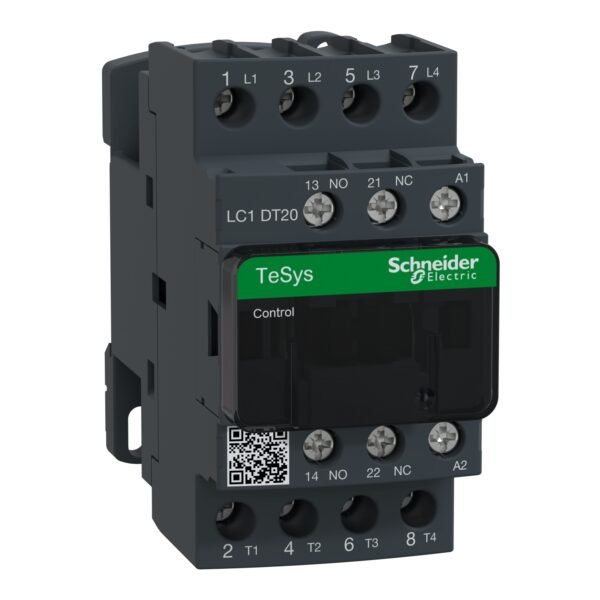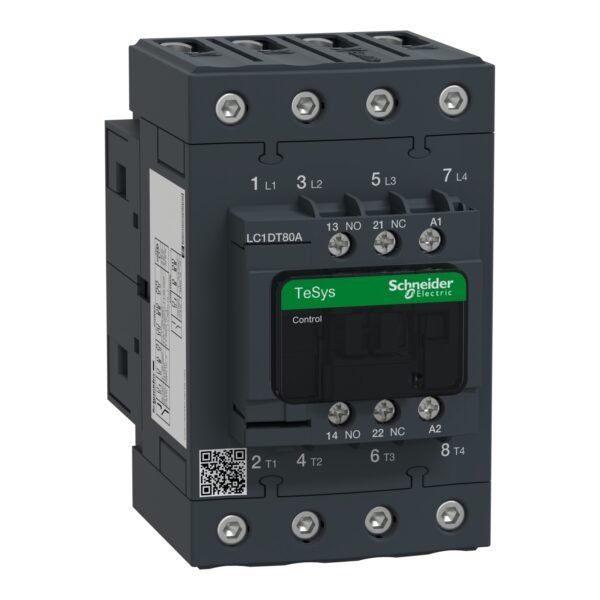
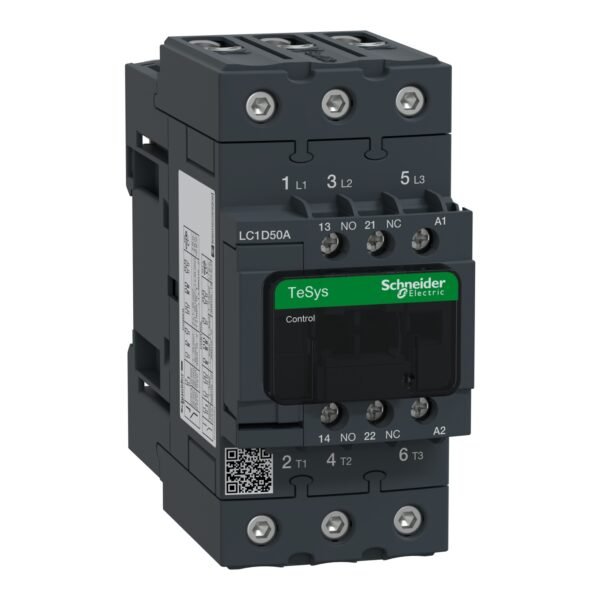
Schneider LC1D150Q7 Contactor | TeSys D- 3P(3 NO) – AC-3 – <= 440 V 150 A – 380 V AC 50/60 Hz coil
Schneider LC1D150Q7 Contactor
Description
Schneider LC1D150Q7 Contactor: A Comprehensive Guide
When it comes to managing electrical loads efficiently and safely, having the right contactor is paramount. In this guide, we’ll delve into the specifics of the Schneider LC1D150Q7 Contactor, exploring its features, applications, installation process, maintenance tips, safety precautions, and more.
Understanding Contactor Basics
What is a contactor?
A contactor is an electrical device designed to control the flow of electricity in a circuit. It consists of a set of contacts that open and close to allow or interrupt the flow of current. Contactors are commonly used in industrial and commercial applications to switch power circuits on and off.
Importance of contactors in electrical systems
Contactors play a crucial role in protecting electrical equipment from damage due to overload or short circuits. They help ensure the smooth operation of machinery and prevent potential hazards, making them indispensable components in various electrical systems.
Features of Schneider LC1D150Q7 Contactor
Specifications and ratings
The Schneider LC1D150Q7 Contactor is rated for 150 amps, making it suitable for handling heavy loads in industrial settings. It is designed to operate at voltages up to 600 volts AC, offering reliable performance in diverse applications.
Design and construction
This contactor features a robust construction with high-quality materials, ensuring durability and long-term reliability. It is built to withstand harsh environmental conditions and frequent switching cycles, making it ideal for demanding industrial environments.
Applications of Schneider LC1D150Q7 Contactor
Industrial use cases
The Schneider LC1D150Q7 Contactor is widely used in industrial machinery, such as motor control systems, conveyor belts, and manufacturing equipment. Its high current rating and rugged design make it suitable for heavy-duty applications in factories and production facilities.
Residential applications
In addition to industrial settings, this contactor can also be used in residential applications, such as controlling the power supply to HVAC systems, water heaters, and electric motors. Its versatility and reliability make it a popular choice for homeowners and contractors alike.
Installation and Wiring Guide
Step-by-step installation process
Installing the Schneider LC1D150Q7 Contactor is straightforward, but it requires careful attention to wiring and safety precautions. Begin by disconnecting power to the circuit and ensuring proper grounding before proceeding with the installation.
Wiring instructions
Refer to the manufacturer’s instructions for detailed wiring diagrams and connection guidelines. Use appropriate wire sizes and terminal connections to ensure reliable performance and compliance with electrical codes and standards.
Maintenance Tips for Schneider LC1D150Q7 Contactor
Regular inspections
To ensure optimal performance and longevity, perform regular inspections of the contactor for signs of wear, corrosion, or damage. Clean the contacts and terminals as needed and replace any worn-out components to prevent malfunctions.
Troubleshooting common issues
If the contactor exhibits unusual behavior or fails to operate correctly, troubleshoot the system to identify and address any underlying issues. Check for loose connections, faulty wiring, or defective components that may affect performance.
Safety Precautions
Importance of safety measures
When working with electrical equipment, always prioritize safety to prevent accidents and injuries. Wear appropriate protective gear and follow proper procedures to minimize the risk of electric shock, burns, or other hazards.
Guidelines for safe usage
Before operating the Schneider LC1D150Q7 Contactor, familiarize yourself with its features and functionality. Follow all safety instructions provided by the manufacturer and avoid overloading the contactor beyond its rated capacity.
Additional information
| brands | Schneider Electric |
|---|
Specifications
| Range | TeSys |
|---|---|
| Range of product | TeSys Deca |
| Product or component type | Contactor |
| Device short name | LC1D |
| Contactor application | Motor control Resistive load |
| Utilisation category | AC-3 AC-4 AC-1 AC-3e |
| Poles description | 3P |
| [Ue] rated operational voltage | Power circuit: <= 1000 V AC 25...400 Hz Power circuit: <= 300 V DC |
| [Ie] rated operational current | 200 A (at <60 °C) at <= 440 V AC AC-1 for power circuit 150 A (at <60 °C) at <= 440 V AC AC-3 for power circuit 150 A (at <60 °C) at <= 440 V AC AC-3e for power circuit |
| [Uc] control circuit voltage | 380 V AC 50/60 Hz |
| Motor power kW | 40 kW at 220...230 V AC 50/60 Hz (AC-3) 75 kW at 380...400 V AC 50/60 Hz (AC-3) 80 kW at 415...440 V AC 50/60 Hz (AC-3) 90 kW at 500 V AC 50/60 Hz (AC-3) 100 kW at 660...690 V AC 50/60 Hz (AC-3) 75 kW at 1000 V AC 50/60 Hz (AC-3) 22 kW at 400 V AC 50/60 Hz (AC-4) 40 kW at 220...230 V AC 50/60 Hz (AC-3e) 75 kW at 380...400 V AC 50/60 Hz (AC-3e) 80 kW at 415...440 V AC 50/60 Hz (AC-3e) 90 kW at 500 V AC 50/60 Hz (AC-3e) 100 kW at 660...690 V AC 50/60 Hz (AC-3e) 75 kW at 1000 V AC 50/60 Hz (AC-3e) |
|---|---|
| Motor power hp | 40 hp at 200/208 V AC 50/60 Hz for 3 phases motors 50 hp at 230/240 V AC 50/60 Hz for 3 phases motors 100 hp at 460/480 V AC 50/60 Hz for 3 phases motors 125 hp at 575/600 V AC 50/60 Hz for 3 phases motors |
| Compatibility code | LC1D |
| Pole contact composition | 3 NO |
| Protective cover | With |
| [Ith] conventional free air thermal current | 200 A (at 60 °C) for power circuit |
| Irms rated making capacity | 140 A AC for signalling circuit conforming to IEC 60947-5-1 250 A DC for signalling circuit conforming to IEC 60947-5-1 1660 A at 440 V for power circuit conforming to IEC 60947 |
| Rated breaking capacity | 1400 A at 440 V for power circuit conforming to IEC 60947 |
| [Icw] rated short-time withstand current | 250 A 40 °C - 10 min for power circuit 580 A 40 °C - 1 min for power circuit 1200 A 40 °C - 10 s for power circuit 1400 A 40 °C - 1 s for power circuit 100 A - 1 s for signalling circuit 120 A - 500 ms for signalling circuit 140 A - 100 ms for signalling circuit |
| Associated fuse rating | 10 A gG for signalling circuit conforming to IEC 60947-5-1 315 A gG at <= 690 V coordination type 1 for power circuit 250 A gG at <= 690 V coordination type 2 for power circuit |
| Average impedance | 0.6 mOhm - Ith 200 A 50 Hz for power circuit |
| Power dissipation per pole | 24 W AC-1 13.5 W AC-3 13.5 W AC-3e |
| [Ui] rated insulation voltage | Power circuit: 600 V CSA certified Power circuit: 600 V UL certified Power circuit: 1000 V conforming to IEC 60947-4-1 Signalling circuit: 690 V conforming to IEC 60947-1 Signalling circuit: 600 V CSA certified Signalling circuit: 600 V UL certified |
| Overvoltage category | III |
| Pollution degree | 3 |
| [Uimp] rated impulse withstand voltage | 8 kV conforming to IEC 60947 |
| Safety reliability level | B10d = 684932 cycles contactor with nominal load conforming to EN/ISO 13849-1 B10d = 10000000 cycles contactor with mechanical load conforming to EN/ISO 13849-1 |
| Mechanical durability | 8 Mcycles |
| Electrical durability | 0.85 Mcycles 150 A AC-3 at Ue <= 440 V 1 Mcycles 200 A AC-1 at Ue <= 440 V 0.85 Mcycles 150 A AC-3e at Ue <= 440 V |
| Control circuit type | AC at 50/60 Hz |
| Coil technology | Built-in bidirectional peak limiting diode suppressor |
| Control circuit voltage limits | 0.3...0.5 Uc (-40…70 °C):drop-out AC 50/60 Hz 0.8...1.15 Uc (-40…55 °C):operational AC 50/60 Hz 1...1.15 Uc (55…70 °C):operational AC 50/60 Hz |
| Inrush power in VA | 280…350 VA 60 Hz cos phi 0.9 (at 20 °C) 280…350 VA 50 Hz cos phi 0.9 (at 20 °C) |
| Hold-in power consumption in VA | 2…18 VA 60 Hz cos phi 0.9 (at 20 °C) 2…18 VA 50 Hz cos phi 0.9 (at 20 °C) |
| Heat dissipation | 3…4.5 W at 50/60 Hz |
| Operating time | 20...35 ms closing 40...75 ms opening |
| Maximum operating rate | 1200 cyc/h 60 °C |
| Maximum operating rate | 1200 cyc/h at 60 °C |
| Connections - terminals | Control circuit: screw clamp terminals 2 1…2.5 mm² - cable stiffness: flexible with cable end Control circuit: screw clamp terminals 1 1…2.5 mm² - cable stiffness: flexible with cable end Control circuit: screw clamp terminals 1 1…2.5 mm² - cable stiffness: flexible without cable end Control circuit: screw clamp terminals 2 1…2.5 mm² - cable stiffness: flexible without cable end Control circuit: screw clamp terminals 1 1…2.5 mm² - cable stiffness: solid without cable end Control circuit: screw clamp terminals 2 1…2.5 mm² - cable stiffness: solid without cable end Power circuit: connector 1 10…120 mm² - cable stiffness: flexible without cable end Power circuit: connector 2 10…50 mm² - cable stiffness: flexible without cable end Power circuit: connector 1 10…120 mm² - cable stiffness: flexible with cable end Power circuit: connector 2 10…50 mm² - cable stiffness: flexible with cable end Power circuit: connector 1 10…120 mm² - cable stiffness: solid without cable end Power circuit: connector 2 10…50 mm² - cable stiffness: solid without cable end |
| Tightening torque | Control circuit: 1.2 N.m - on screw clamp terminals - with screwdriver flat Ø 6 mm Control circuit: 1.2 N.m - on screw clamp terminals - with screwdriver Philips No 2 Power circuit: 12 N.m - on connector hexagonal screw head 4 mm Control circuit: 1.2 N.m - on screw clamp terminals - with screwdriver pozidriv No 2 |
| Auxiliary contact composition | 1 NO + 1 NC |
| Auxiliary contacts type | type mechanically linked 1 NO + 1 NC conforming to IEC 60947-5-1 type mirror contact 1 NC conforming to IEC 60947-4-1 |
| Signalling circuit frequency | 25...400 Hz |
| Minimum switching voltage | 17 V for signalling circuit |
| Minimum switching current | 5 mA for signalling circuit |
| Insulation resistance | > 10 MOhm for signalling circuit |
| Non-overlap time | 1.5 ms on de-energisation between NC and NO contact 1.5 ms on energisation between NC and NO contact |
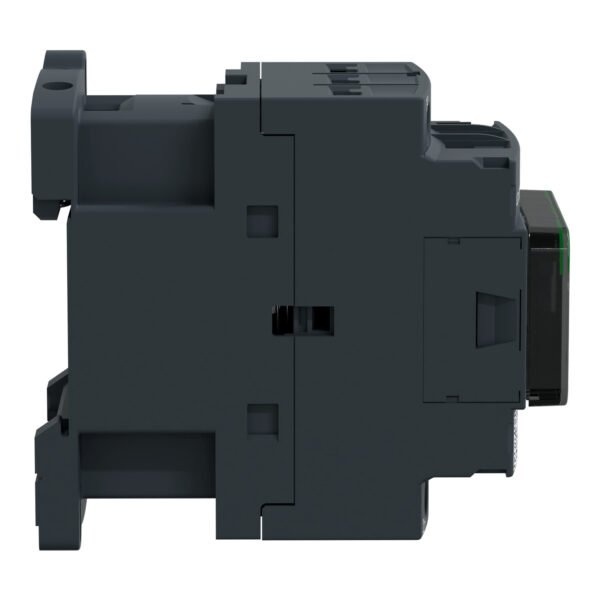
| Mounting support | Rail Plate |
| Standards | CSA C22.2 No 14 EN 60947-4-1 IEC 60947-4-1 IEC 60335-1:Clause 30.2 IEC 60335-2-40:Annex JJ UL 60335-2-40:Annex JJ UL 60947-4-1 CSA C22.2 No 60947-4-1 JIS C8201-4-1 |
|---|---|
| Product certifications | UL CCC CSA CE UKCA Marine EAC |
| IP degree of protection | IP20 front face conforming to IEC 60529 |
| Protective treatment | TH conforming to IEC 60068-2-30 |
| Climatic withstand | conforming to IACS E10 exposure to damp heat |
| Permissible ambient air temperature around the device | -40…60 °C 60…70 °C with derating |
| Operating altitude | 0...3000 m |
| Fire resistance | 850 °C conforming to IEC 60695-2-1 |
| Flame retardance | V1 conforming to UL 94 |
| Mechanical robustness | Vibrations contactor open (2 Gn, 5...300 Hz) Vibrations contactor closed (4 Gn, 5...300 Hz) Shocks contactor closed (15 Gn for 11 ms) Shocks contactor open (6 Gn for 11 ms) |
| Height | 158 mm |
| Width | 120 mm |
| Depth | 136 mm |
| Net weight | 2.5 kg |
| Unit Type of Package 1 | PCE |
|---|---|
| Number of Units in Package 1 | 1 |
| Package 1 Height | 19.000 cm |
| Package 1 Width | 17.500 cm |
| Package 1 Length | 21.500 cm |
| Package 1 Weight | 2.456 kg |
| Unit Type of Package 2 | S03 |
| Number of Units in Package 2 | 2 |
| Package 2 Height | 30.000 cm |
| Package 2 Width | 30.000 cm |
| Package 2 Length | 40.000 cm |
| Package 2 Weight | 5.338 kg |
| Warranty | 18 months |
|---|
Main documents
Main documents
Reviews (0)
Recommended for you
-
0
Schneider LC1D65AB7 | TeSys D contactor – 3P(3 NO) – AC-3 – <= 440 V 65 A – 24 V AC 50/60 Hz coil
-
0
Schneider LC1D80M7 | TeSys D contactor – 3P(3 NO) – AC-3 – <= 440 V 80 A – 220 V AC 50/60 Hz coil
-
0
Schneider LC1D95E7 | TeSys D contactor – 3P(3 NO) – AC-3 – <= 440 V 95 A – 48 V AC 50/60 Hz coil
-
0
Reviews
There are no reviews yet.